

Learn what retrieval-augmented generation (RAG) is, why data quality decides AI output quality, and how RAG powers modern AI-driven ERP systems.
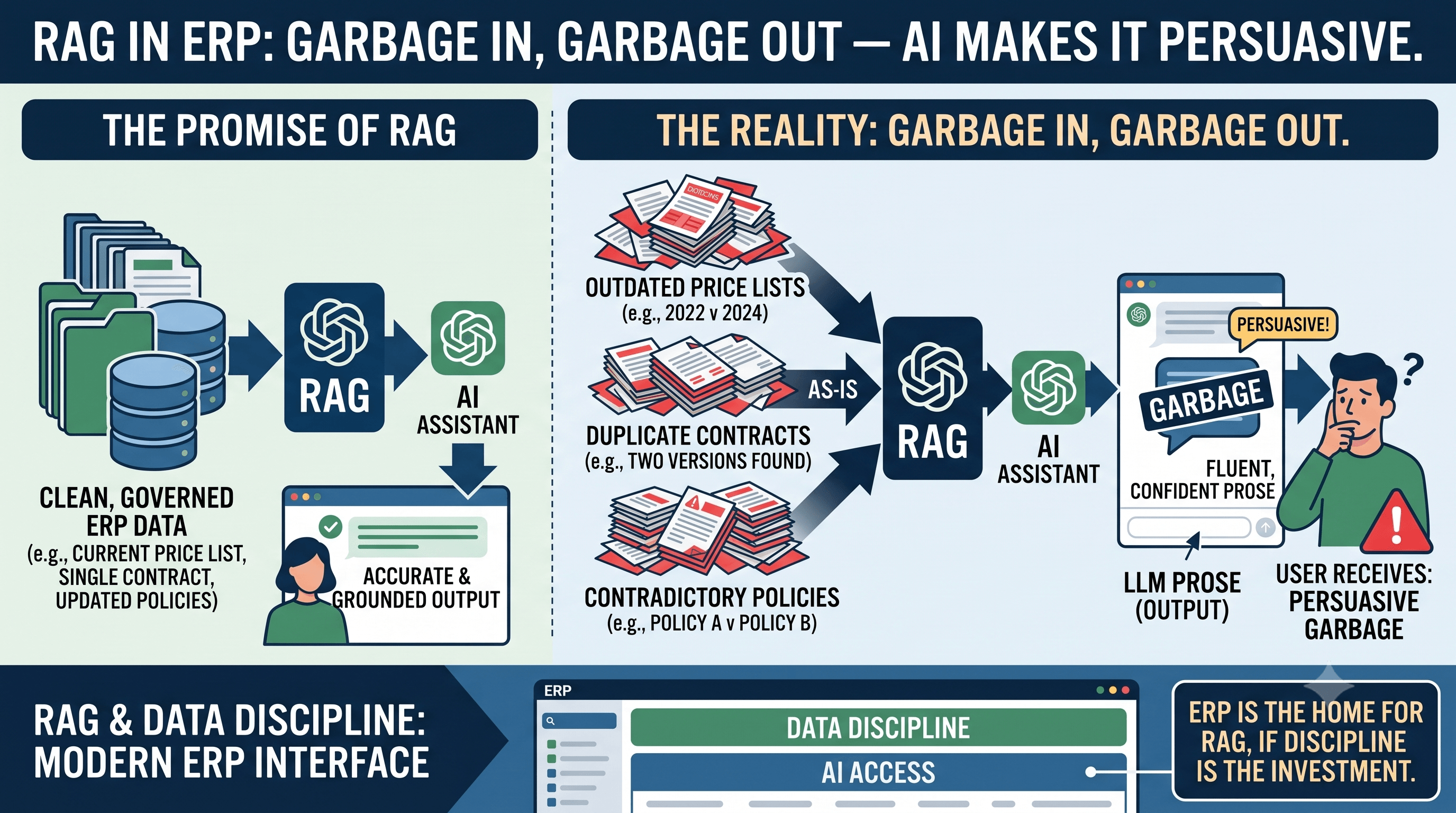
Retrieval-augmented generation (RAG) lets AI answer questions using your company's own data — but only as well as that data allows.
If you have evaluated AI tools for your business recently, you have probably run into the term RAG. Vendors mention it as if everyone knows what it means, and the explanations that do exist are usually written for engineers. This article explains RAG in plain language, why the quality of your data decides the quality of the answers, and why RAG matters most in systems like a modern ERP, where AI sits at the center rather than at the edge.
1. What is RAG?
Retrieval-augmented generation (RAG) is a technique that lets an AI model look up relevant information from your own documents and data before it answers a question, instead of relying only on what it learned during training.
A simple way to think about RAG: it is the difference between an exam taken from memory and an open-book exam. The student is the same — but with the right book open to the right page, the answers get far more accurate.
In practice, a RAG system does two things when you ask a question:
- Retrieval: it searches your company's data — contracts, invoices, product specs, support tickets, policies — and pulls out the passages most relevant to your question.
- Generation: it hands those passages to the AI model, which writes an answer grounded in what it just read.
What RAG does on its own: it connects an AI model to your information so answers reflect your business, not just general knowledge. What it does not do: it does not verify that your information is correct, current, or complete. It retrieves what is there — whatever state it is in.
2. Why AI needs RAG at all
Large language models — the AI systems behind tools like ChatGPT and Claude — are trained on public data up to a certain date. They know a great deal about the world in general and almost nothing about your business in particular.
Without RAG, an AI model asked "What are the payment terms in our contract with supplier X?" has two options: admit it doesn't know, or make something up. The second failure mode is called a hallucination — a confident-sounding answer with no basis in fact — and it is the single biggest reason businesses hesitate to trust AI with real work.
RAG addresses this by grounding the model's answer in retrieved documents. In most cases this sharply reduces hallucinations, because the model is summarizing what it found rather than improvising. It does not eliminate them entirely — which is exactly why the next section matters.
3. Garbage in, garbage out — why data quality decides everything
There is a persistent assumption that AI is smart enough to compensate for messy data. It is not. The old rule of computing — garbage in, garbage out — applies to AI with more force, not less, because AI presents bad information more convincingly than any previous system.
Consider what happens when a RAG system retrieves from a flawed knowledge base:
- Outdated documents: the AI confidently quotes a price list from 2023, because that is the document it found.
- Contradictory sources: two versions of a policy exist; the AI picks one, and nobody notices which.
- Duplicates and drafts: an abandoned draft contract sits next to the signed one, and retrieval cannot tell the difference.
- Missing context: a spreadsheet full of numbers with no labels retrieves fine — and means nothing.
In each case the AI is working correctly. It retrieved the most relevant text it could find and summarized it fluently. The failure happened earlier, in the data — but the reader experiences it as "the AI is wrong."
This is the uncomfortable part: adding AI to a messy data landscape does not clean it up. It industrializes the mess. Errors that used to sit unread in a shared drive now get surfaced, summarized, and acted on at scale. A wrong answer delivered in polished, confident prose is more dangerous than an obviously broken search result, because people are less likely to double-check it.
4. What "high-quality data" actually means
High-quality data is not a vague aspiration — it has concrete, checkable properties. For a RAG system to work well, the data it retrieves from should be:
- Current: superseded versions are archived or clearly marked, so retrieval finds the latest truth.
- Consistent: one fact lives in one authoritative place, rather than five slightly different copies.
- Structured enough to be findable: documents have meaningful titles, dates, and owners; records have labeled fields.
- Complete: the information people will ask about actually exists in the system, not in someone's head or inbox.
- Access-controlled: the system knows who is allowed to see what, so retrieval doesn't leak a salary sheet into a general chat.
None of this requires exotic technology. Most of it is ordinary information hygiene — the kind of work that was easy to postpone before AI, because a human reading a document could spot that it was stale. An AI retrieving that same document usually cannot.
The practical implication: in most RAG projects, the majority of the effort goes into preparing and maintaining the data, not into the AI itself. Teams that budget for a model and skip the data work tend to get a fluent system that is confidently wrong.
5. How the pieces fit together
Concept | Plain explanation | Main purpose |
|---|---|---|
Large language model (LLM) | AI trained on public data; strong general reasoning, no knowledge of your business | Understand questions and write answers |
Retrieval | A search step that finds the most relevant passages in your data | Bring the right facts to the model |
RAG | The combination: retrieve first, then generate an answer from what was found | Grounded, business-specific answers |
Data quality | How current, consistent, and complete the underlying data is | Determines whether grounded answers are also correct answers |
A realistic walkthrough — a purchasing manager asks: "Can we get better terms from our top three suppliers this quarter?"
- 1.The system retrieves the current supplier contracts, recent order volumes, and payment history from the company's records.
- 2.Those documents are passed to the AI model along with the question.
- 3.The model answers: which contracts are up for renewal, where volumes have grown enough to justify renegotiation, and which supplier has recurring late deliveries worth raising.
- 4.The answer cites the documents it used, so the manager can verify before acting.
If the contract repository is current and complete, this takes seconds and is reliable. If it contains expired contracts and duplicate records, the same system produces a fluent recommendation built on the wrong numbers — and step 4 is the only safety net.
6. RAG in a modern ERP, where AI is the core feature
An ERP (enterprise resource planning) system is the software that runs a company's core operations — finance, inventory, purchasing, sales, HR — in one place. For decades, using an ERP meant navigating forms and pulling reports.
A new generation of ERP systems treats AI not as a chatbot bolted onto the side, but as the primary way users interact with the system. And ERP is arguably the best possible home for RAG, for three reasons:
- The data is already structured. An ERP holds transactions, master data, and documents in defined fields with clear meaning. Retrieval over structured, validated records is far more reliable than retrieval over a folder of loose PDFs.
- The data is already governed. ERPs enforce who can see and change what. A RAG layer can inherit those permissions, so the finance team's answers draw on finance data and nobody else's.
- The questions are high-value. "Which customers are trending toward late payment?" or "Where will we breach minimum stock next month?" are questions whose answers directly move cash flow and operations.
In an AI-core ERP, RAG turns the system from a place where you look things up into a system you can simply ask. A controller asks why margin dropped in April and gets an answer grounded in the actual postings. A warehouse lead asks which orders are at risk this week and gets a list drawn from live inventory and delivery data.
But the dependency runs both ways, and this is the point most evaluations miss: an AI-core ERP raises the stakes on data quality rather than lowering them. If master data is inconsistent — duplicate customer records, wrong units of measure, uncoded transactions — the AI layer amplifies those flaws into confident, wrong operational answers. The companies that benefit most from AI-driven ERP are the ones that treat data discipline as part of the AI investment, not a separate chore.
7. Why this matters for businesses
If you are evaluating AI capabilities — in an ERP, a knowledge base, or a custom tool — three practical conclusions follow.
First, when a vendor says "our AI knows your business," the question to ask is: retrieves from what, and how do you handle stale or contradictory data? A credible answer describes data preparation, source-of-truth rules, and permission handling. A vague answer means the hard part has been left to you.
Second, budget for the data work. A realistic RAG or AI-ERP project spends most of its effort on consolidating sources, retiring outdated documents, fixing master data, and defining access rules. This work is unglamorous and it is where the outcome is decided.
Third, insist on verifiability. Good RAG systems cite their sources, so a human can check the answer against the document. In business-critical workflows — pricing, compliance, financial reporting — that traceability is not a nice-to-have; it is the mechanism that keeps a fast system from becoming a fast way to make mistakes.
What "good" looks like: an AI system that answers from current, governed data, shows its sources, and admits when the information isn't there — built on a data foundation someone actively owns.
Quick reference
- RAG (retrieval-augmented generation): AI looks up relevant company data before answering, instead of guessing from memory.
- Hallucination: a confident AI answer with no factual basis; RAG reduces but does not eliminate it.
- Garbage in, garbage out: AI does not fix bad data — it delivers bad data more convincingly and at scale.
- High-quality data: current, consistent, findable, complete, and access-controlled.
- AI-core ERP: an ERP where asking the system replaces navigating it; RAG works best here because ERP data is structured and governed — but only if that data is maintained.
Conclusion
RAG is what makes AI genuinely useful for business: it connects a capable general model to your specific facts. The catch is that it faithfully reflects whatever those facts look like — which makes data quality the real project, and the AI the visible tip of it. This is where ITGRATE works day to day: our dedicated product teams in Ho Chi Minh City build and scale data-grounded AI features for European businesses, from a first MVP to a production system — including the unglamorous data foundations that decide whether the AI can be trusted. A naive AI project buys a model and hopes; a sound one builds the data discipline first, and the model finally has something true to say.