

A non-technical guide to understanding LLMs, AI agents, skills, tools, MCP, hooks and agent orchestration — and how they work together in modern AI systems.
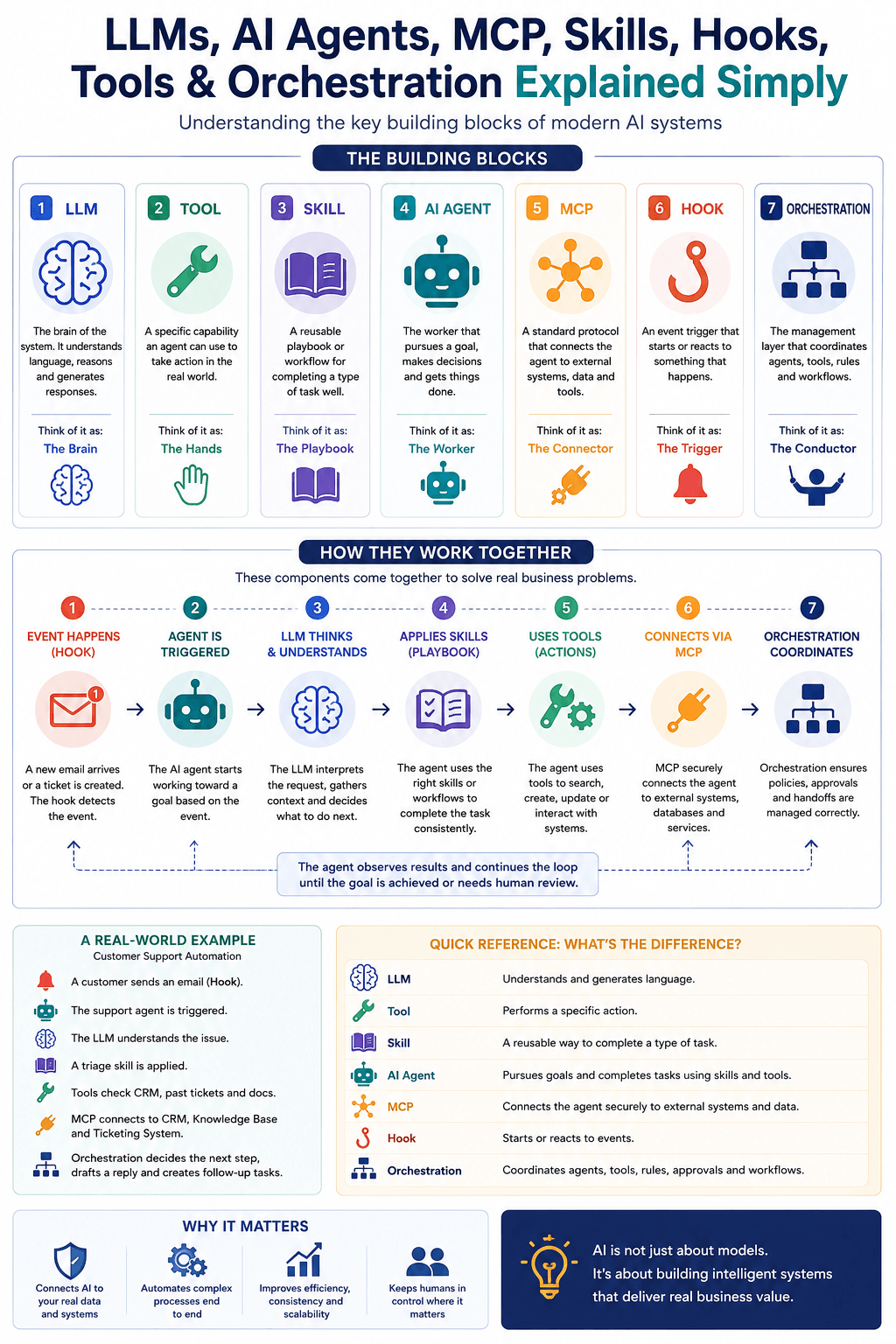
Artificial intelligence is moving fast. Terms like LLM, AI agent, MCP, skills, tools, hooks and agent orchestration are now used in business discussions, product roadmaps and technology strategies.
The challenge is that many of these terms sound similar. They are often used interchangeably, even though they describe different layers of an AI system.
This article explains these concepts in simple terms and shows how they fit together.
1. What is an LLM?
An LLM, or Large Language Model, is the core intelligence behind many modern AI systems.
Examples include models that can understand text, generate answers, summarize documents, write code, translate languages or reason through business questions.
A simple way to understand an LLM:
An LLM is the “brain” that understands language and generates responses.
However, by itself, an LLM usually does not automatically know your company data, access your systems, send emails, update tickets or execute business workflows. It can reason and generate output, but it needs additional components to take action.
2. What is a Tool for an AI Agent?
A tool is something an AI system can use to perform a specific action.
For example, an AI agent might use tools to:
- Search a database
- Read a document
- Create a Jira ticket
- Send an email draft
- Check a calendar
- Query a CRM
- Generate a report
- Call an internal API
A simple way to understand tools:
Tools are the “hands” of an AI system.
The LLM can decide what should be done. Tools allow the system to actually do it.
Without tools, the AI can only answer. With tools, it can interact with real systems.
3. What is a Skill?
A skill is a reusable capability or workflow that tells an AI system how to perform a certain type of task.
For example, a company could define skills such as:
- Summarize a sales call
- Prepare a project status report
- Review a software specification
- Triage support tickets
- Analyze customer feedback
- Generate onboarding documents
A simple way to understand a skill:
A skill is a packaged know-how for a recurring task.
A tool is usually a function or action. A skill is more like a structured method or playbook.
For example:
- Tool: “Read this CRM record”
- Skill: “Prepare a complete customer account summary using CRM data, support history and recent emails”
Skills help make AI behavior more consistent, repeatable and aligned with company processes.
4. What is an AI Agent?
An AI agent is an AI system that can pursue a goal, make decisions, use tools and complete multi-step tasks.
A chatbot usually responds to a user message. An agent can go further by planning steps, choosing tools and adapting based on results.
For example, instead of only answering:
“Here is a summary of the customer complaint.”
An AI agent could:
- 1.Read the customer email
- 2.Check the CRM
- 3.Review past support tickets
- 4.Draft a response
- 5.Create an internal follow-up task
- 6.Escalate the issue if needed
A simple way to understand an agent:
An AI agent is a goal-oriented AI worker that can reason, use tools and execute workflows.
The LLM is the brain. Tools are the hands. Skills are reusable know-how. The agent combines them to complete work.
5. What is MCP?
MCP stands for Model Context Protocol.
It is a standard way for AI systems to connect with external tools, data sources and applications.
A simple way to understand MCP:
MCP is like a universal adapter that helps AI systems connect to different business systems.
Instead of building a custom integration for every AI model and every tool, MCP provides a more standardized connection layer.
For businesses, this matters because AI systems often need access to:
- Internal documents
- Databases
- Project management tools
- CRM systems
- Code repositories
- Cloud services
- Knowledge bases
- Business applications
MCP helps make these connections more structured, reusable and easier to manage.
6. What are Hooks?
Hooks are triggers that allow an AI workflow to start, stop or react when something happens.
Examples:
- A new support ticket is created
- A customer sends an email
- A document is uploaded
- A payment fails
- A deployment is completed
- A project status changes
- A security alert is detected
A simple way to understand hooks:
Hooks are event triggers that tell an AI system when to act.
For example, when a new support ticket arrives, a hook could trigger an AI agent to classify the issue, summarize it and suggest the next action.
Hooks are important because they move AI from passive chat into active workflow automation.
7. What is Agent Orchestration?
Agent orchestration means coordinating multiple AI agents, tools, workflows and rules so they work together safely and effectively.
In simple cases, one agent may be enough. In more complex business environments, different agents may have different responsibilities.
For example:
- A research agent gathers information
- A support agent drafts a response
- A compliance agent checks the wording
- A project agent creates follow-up tasks
- A human approves the final action
A simple way to understand agent orchestration:
Agent orchestration is the management layer that coordinates AI agents, tools, data and human approvals.
It helps answer questions such as:
- Which agent should handle this task?
- Which tools are allowed?
- When does a human need to approve?
- What happens if the AI is uncertain?
- How are errors handled?
- How is the workflow logged and monitored?
Agent orchestration becomes especially important when AI is used in real business processes, not just experiments.
8. How These Concepts Fit Together
A practical AI agent system usually contains several layers:
Concept | Simple Explanation | Main Purpose |
|---|---|---|
LLM | The brain | Understands and generates language |
Tool | The hands | Performs specific actions |
Skill | The playbook | Provides reusable task knowledge |
Agent | The worker | Pursues goals and completes tasks |
MCP | The connector | Links AI to external systems |
Hook | The trigger | Starts or reacts to events |
Orchestration | The manager | Coordinates agents, tools and workflows |
A simplified example:
A customer sends an email about a software bug.
- 1.A hook detects the new email.
- 2.An AI agent starts the support workflow.
- 3.The agent uses an LLM to understand the message.
- 4.It applies a skill for ticket triage.
- 5.It uses tools to check the CRM, project board and support history.
- 6.It connects to systems through MCP or similar integration layers.
- 7.Agent orchestration decides whether the answer can be drafted automatically or needs human review.
This is how modern AI moves from simple conversation to business process automation.
9. Why This Matters for Businesses
For non-technical decision makers, the key point is not the terminology itself. The key point is understanding what kind of AI system your business actually needs.
A simple chatbot may be enough if you only want basic Q&A.
But if you want AI to support real business operations, you need more than an LLM. You need a structured system with:
- Secure access to company data
- Well-defined tools
- Reusable skills
- Clear workflows
- Human approval points
- Monitoring and logging
- Integration with existing systems
- Governance and security rules
This is where many AI projects fail. Companies often start with a model, but underestimate the architecture around the model.
The value is not created by the LLM alone. The value comes from connecting intelligence with business context, systems and processes.
10. How to Distinguish the Terms
Here is a simple way to remember the difference:
- LLM: Thinks and writes
- Tool: Does a specific action
- Skill: Knows how to perform a recurring task
- Agent: Works toward a goal
- MCP: Connects the agent to external systems
- Hook: Starts the workflow when something happens
- Orchestration: Coordinates the full process
The more business-critical the use case, the more important the surrounding architecture becomes.
Conclusion
LLMs are powerful, but they are only one part of modern AI systems.
To build useful AI solutions for real businesses, companies need to understand the full stack: models, agents, tools, skills, integrations, hooks and orchestration.
This distinction helps teams avoid unrealistic expectations and design AI systems that are practical, secure and scalable.
At ITGRATE, we help businesses move from AI ideas to working software systems. Whether you want to explore internal AI assistants, workflow automation or agent-based business applications, the right starting point is a clear understanding of your processes, data and integration needs.
A good AI solution does not begin with hype. It begins with architecture.