

Learn how Modbus protocol enables reliable solar tracker communication. Explore Modbus RTU vs TCP implementation, real-world applications, and best practices for PV tracking systems.
Estimated Reading Time: 8 minutes
Disclaimer: This article provides educational technical information about Modbus protocol implementation in solar tracking systems based on industry best practices and publicly available standards. The content is intended for general guidance and should not substitute for professional engineering design, equipment manufacturer specifications, or compliance with applicable codes and regulations. Implementation details vary by equipment, site conditions, and regulatory requirements. Consult qualified engineers and equipment vendors for specific system design and deployment.
Solar panel tracker systems represent a significant advancement in photovoltaic (PV) efficiency, increasing energy capture by 25-45% compared to fixed-tilt installations. At the heart of these sophisticated systems lies a robust communication protocol that has proven its worth across decades of industrial automation: Modbus. This guide explores why Modbus protocol has become the de facto standard for solar tracker communication and how to implement it effectively in modern PV installations.
Introduction to Modbus Protocol
Modbus protocol, developed by Modicon (now Schneider Electric) in 1979, remains one of the most widely adopted industrial communication protocols worldwide. Its longevity stems from a fundamental design philosophy: simplicity, reliability, and openness.
What Makes Modbus Special?
Modbus operates on a master-slave (client-server) architecture where a central controller requests data from multiple field devices. The protocol supports four primary data types:
- Coils: Single-bit read/write values (digital outputs)
- Discrete Inputs: Single-bit read-only values (digital inputs)
- Holding Registers: 16-bit read/write values (analog outputs, configuration)
- Input Registers: 16-bit read-only values (analog inputs, sensor data)
This straightforward data model translates perfectly to solar tracker requirements, where controllers need to read sensor data (sun position, wind speed, temperature) and write commands to drive motors and actuators.
Essential Modbus Function Codes
Modbus communication uses function codes to specify the type of operation. Key function codes for solar tracker applications include:
- FC01 (Read Coils): Read digital outputs (e.g., motor enable status, relay states)
- FC02 (Read Discrete Inputs): Read digital inputs (e.g., limit switches, alarm contacts)
- FC03 (Read Holding Registers): Read analog values and configuration parameters (most commonly used)
- FC04 (Read Input Registers): Read analog sensor data (e.g., position sensors, temperature)
- FC05 (Write Single Coil): Control individual outputs (e.g., enable/disable motor)
- FC06 (Write Single Register): Write configuration parameters or setpoints
- FC16 (Write Multiple Registers): Efficiently write several parameters in one transaction
- FC23 (Read/Write Multiple Registers): Atomic read-modify-write operations
Understanding which function codes your devices support is essential during system design, as not all devices implement all functions.
Modbus in Industrial Automation
The protocol's royalty-free, open standard has fostered widespread adoption across manufacturing, building automation, energy management, and renewable energy sectors. In industrial automation, Modbus enables interoperability between devices from different manufacturers—a critical advantage when integrating solar tracking systems with existing SCADA (Supervisory Control and Data Acquisition) infrastructure.
Why Modbus Excels in Solar Tracking Applications
Solar panel tracker systems present unique communication requirements that align exceptionally well with Modbus protocol capabilities.
Environmental Resilience
Modbus RTU, transmitted over RS-485 physical layer, demonstrates remarkable resilience in outdoor environments typical of solar installations. RS-485 supports:
- Long-distance communication: Up to 4,000 feet (1,200 meters) without repeaters, though practical distances depend on baud rate and cable quality
- Noise immunity: Differential signaling resists electromagnetic interference from inverters and power equipment
- Multi-drop capability: Traditional RS-485 transceivers support 32 unit loads per segment. Modern low-power transceivers (1/4 or 1/8 unit load) enable 128+ devices on a single bus segment. Modbus protocol itself supports up to 247 slave addresses (addresses 1-247, with 0 reserved for broadcast)
These characteristics prove essential when connecting distributed tracker controllers across large solar farms spanning hundreds of acres.
Real-Time Performance
Solar trackers require consistent, predictable communication to optimize panel positioning throughout the day. Modbus RTU response time for a single query (reading a few registers from one device) typically ranges from 10-100 milliseconds depending on baud rate and message size. However, in multi-device networks, the complete polling cycle time depends on the number of devices, data points per device, and bus configuration. For example, polling 30 devices at 19,200 baud for basic status data might require 5-10 seconds for a complete cycle. This deterministic, predictable behavior is well-suited for tracking algorithms that adjust panel angles every few minutes based on solar ephemeris calculations and sensor feedback.
Cost-Effectiveness
Unlike proprietary protocols requiring expensive licensing or specialized hardware, Modbus implementation requires minimal investment:
- Standard RS-485 transceivers cost $2-5 per device
- Open-source software libraries available for all major platforms
- No recurring licensing fees or vendor lock-in
- Simplified technician training due to widespread familiarity
For utility-scale solar installations with thousands of trackers, these cost savings compound significantly.
Modbus RTU vs Modbus TCP: Technical Comparison
Solar tracker deployments can leverage two primary Modbus variants, each suited to different architectural requirements.
Modbus RTU Characteristics
Modbus RTU (Remote Terminal Unit) transmits data in compact binary format over serial communication lines:
Advantages:
- Minimal bandwidth requirements (9,600 to 115,200 baud typical)
- No network infrastructure needed
- Deterministic timing for predictable response
- Proven reliability in harsh environments
Typical Application: Direct connection of tracker rows to local controllers in field-mounted enclosures.
Message Structure Example:
This request reads two holding registers starting at address 0000 from device ID 01, using function code 03 (read holding registers), with CRC-16 error checking (C40B).
Modbus TCP/IP Characteristics
Modbus TCP encapsulates Modbus messaging in TCP/IP packets, enabling communication over Ethernet networks:
Advantages:
- Higher bandwidth (10/100/1000 Mbps)
- Integration with existing IT infrastructure
- Remote monitoring via internet connectivity
- Support for more devices (limited only by IP addressing)
Typical Application: Communication between field controllers and central SCADA systems, or between tracker blocks and site supervisors.
Message Structure Example:
The same register read request, now wrapped in TCP/IP with transaction tracking for reliable delivery.
Selection Criteria for Solar Applications
Most modern solar tracker installations employ a hybrid approach:
- Modbus RTU: Local communication within tracker rows (controller to motors, sensors)
- Modbus TCP: Site-level communication (field controllers to central SCADA, cloud monitoring)
This architecture optimizes for both local reliability and enterprise-level data integration.
Communication Architecture in Solar Tracker Systems
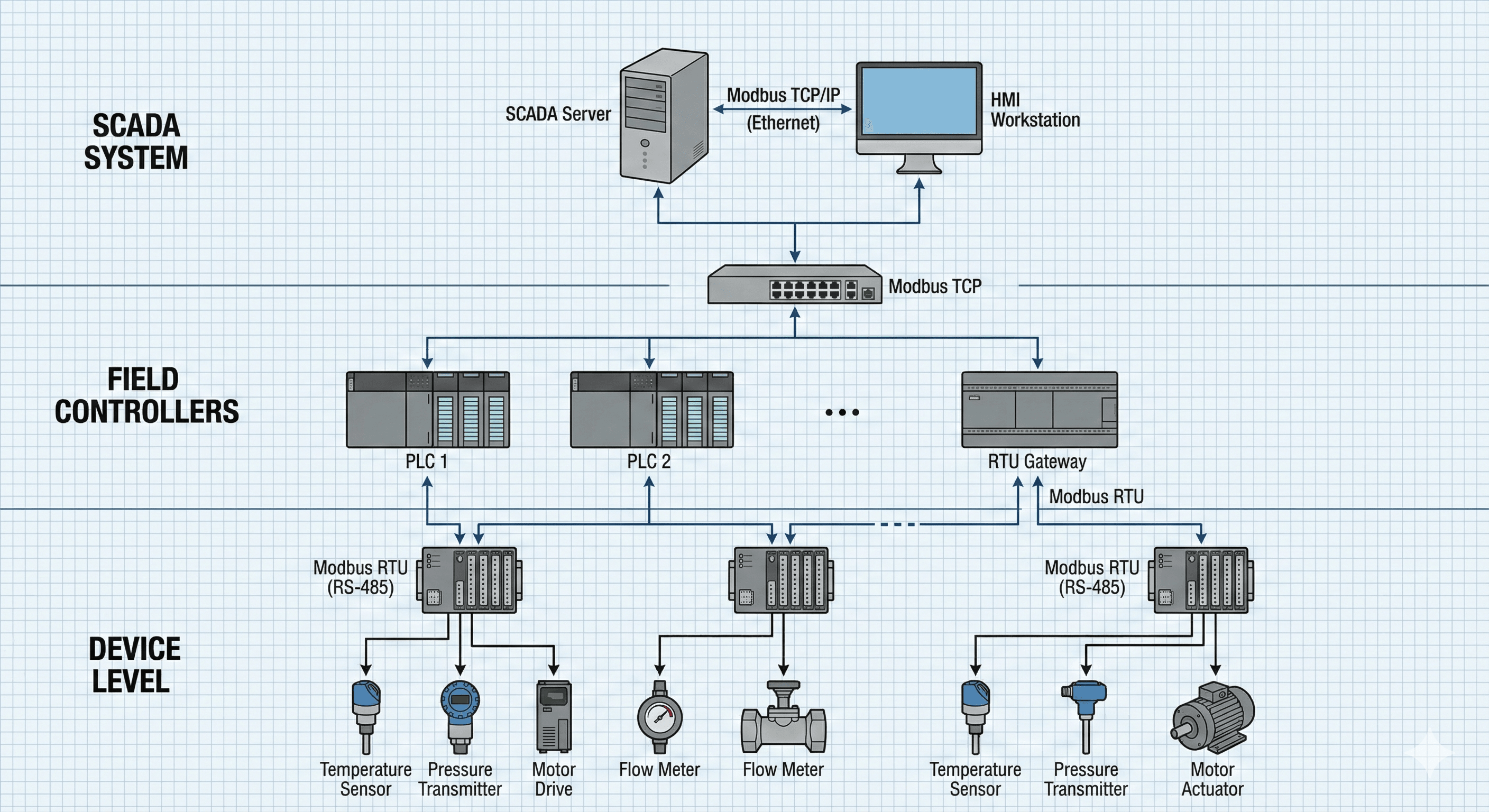
A comprehensive solar tracker communication system typically implements a three-tier Modbus architecture:
Tier 1: Device Level (Modbus RTU)
Individual tracker components communicate via Modbus RTU on RS-485:
Connected Devices:
- Motor controllers: Receive positioning commands, report actual angle
- Inclinometers: Provide precise tilt angle measurements
- Wind sensors: Enable protective stow position during high winds
- Temperature sensors: Monitor panel and equipment temperatures
Typical Register Mapping:
Note on Address Notation: The 5-digit addressing shown above (30001, 40001) is a common vendor convention where the first digit indicates data type (3=Input Register, 4=Holding Register) and the remaining digits indicate the offset (starting from 1). In the actual Modbus protocol, these would be addressed as register 0, 1, 2, etc. Always consult equipment documentation for the specific addressing convention used.
Data Type Encoding and Byte Order
A critical implementation detail when working with 32-bit values (like the angle registers above spanning two 16-bit registers):
Byte Order Variations:
Modbus protocol specifies network byte order (big-endian) for protocol fields, but does not specify byte/word order for multi-register data values. This leads to four possible arrangements for 32-bit values:
- Big-endian (ABCD): Most significant word first, most significant byte first
- Little-endian (DCBA): Least significant word first, least significant byte first
- Big-endian byte swap (BADC): Most significant word first, bytes swapped
- Little-endian byte swap (CDAB): Least significant word first, bytes swapped
Practical Impact:
Different device manufacturers use different conventions, potentially causing misinterpreted values if not properly configured. During system integration, verify byte order with test values and document the convention in register maps. Most SCADA systems provide configuration options to handle different byte order schemes.
Tier 2: Field Controller Level (Modbus RTU/TCP Gateway)
Field controllers aggregate data from multiple tracker rows and communicate with the central system:
Functions:
- Poll device-level Modbus RTU slaves (typically 10-50 trackers per controller)
- Execute local control algorithms (sun position calculation, backtracking)
- Gateway Modbus RTU data to Modbus TCP for upstream systems
- Maintain autonomous operation if central communication fails
Communication Pattern:
The field controller operates as Modbus master to downstream devices and Modbus slave to the central SCADA system.
Tier 3: SCADA Level (Modbus TCP)
Central monitoring and control system:
Capabilities:
- Monitor performance across entire solar farm
- Implement site-wide control strategies
- Data logging and performance analytics
- Integration with weather forecasting and grid management systems
- Remote access for operations and maintenance teams
Protocol Translation:
Modern SCADA systems often translate Modbus TCP to other protocols (OPC UA, MQTT, RESTful APIs) for integration with enterprise systems and cloud platforms.
Broadcast Messaging for Emergency Operations
Modbus RTU supports broadcast messaging using address 0, enabling simultaneous commands to all devices on a bus segment without individual addressing. This capability proves invaluable in solar tracker systems for emergency scenarios:
Common Broadcast Applications:
- Emergency stow: Command all trackers to horizontal position during severe weather warnings
- Synchronized positioning: Move all trackers to identical angle simultaneously
- System-wide mode changes: Switch entire array between automatic and manual control
- Mass configuration updates: Set common parameters across all devices
Important Considerations:
- Broadcast commands receive no response from slaves (fire-and-forget operation)
- No error confirmation - critical commands should be followed by individual polling to verify execution
- Use broadcast sparingly to avoid bus congestion
- Document broadcast command sequences in system safety procedures
This one-to-many communication pattern significantly reduces response time during critical events compared to sequential individual commands.
Key Benefits for Solar Tracking Applications
Reliability and Determinism
Modbus protocol implements robust error detection through CRC-16 (RTU) or TCP checksums, ensuring data integrity critical for precise tracker positioning. The master-slave architecture eliminates collision-based access issues common in other protocols, providing deterministic communication timing.
In practice, properly implemented Modbus networks achieve 99.9%+ uptime, with automatic retry mechanisms handling temporary disruptions from electrical noise or interference.
Vendor Interoperability
The Modbus organization maintains the protocol specification as an open standard, enabling multi-vendor system integration. Solar farm operators can:
- Source tracker controllers from specialized manufacturers
- Integrate weather stations from meteorological equipment suppliers
- Deploy SCADA software from industrial automation vendors
- Replace or upgrade components without system-wide redesign
This flexibility protects against vendor obsolescence and enables competitive procurement.
Simplified Diagnostics
Modbus protocol transparency simplifies troubleshooting:
Diagnostic Tools:
- Protocol analyzers display raw message traffic
- Modbus polling software tests individual devices
- Exception codes identify specific communication failures
Common Exception Codes:
01: Illegal function (unsupported command)02: Illegal data address (register doesn't exist)03: Illegal data value (out-of-range parameter)04: Slave device failure (hardware error)
Maintenance technicians can identify and resolve issues without specialized vendor support, reducing downtime and operational costs.
Scalability
From pilot installations with dozens of trackers to utility-scale deployments with tens of thousands, Modbus architecture scales efficiently:
- Small systems: Single field controller with Modbus RTU devices
- Medium systems: Multiple field controllers on Modbus TCP network
- Large systems: Hierarchical architecture with sector controllers, field controllers, and device-level networks
The protocol imposes no architectural limits—scalability depends only on network design and controller processing capacity.
Real-World Implementation and Best Practices
Best Practice 1: Proper RS-485 Network Design
Topology: Implement true daisy-chain topology, not star or multi-drop stubs. Stubs exceeding 1 meter introduce signal reflections causing communication errors.
Termination: Install 120-ohm termination resistors at both physical ends of each RS-485 bus. Missing or incorrect termination is the leading cause of Modbus RTU reliability issues.
Cable Specification: Use twisted-pair cable designed for RS-485 (not standard Category 5). Recommended specifications:
- 24 AWG twisted pair
- 120-ohm characteristic impedance
- Foil or braid shield grounded at one end only
- UV-resistant jacket for outdoor routing
Best Practice 2: Optimize Polling Intervals
Balance data freshness with bus utilization based on device count and baud rate:
Critical Safety Data (wind speed, emergency stops): Poll every 5 seconds from dedicated sensors or subset of devices
Control Data (position feedback, motor status): Poll every 15-30 seconds for routine tracking adjustments
Monitoring Data (temperature, energy metrics): Poll every 60-300 seconds depending on system size
Configuration Data (operating parameters): Read on-demand or during scheduled maintenance windows
Polling Cycle Design Example:
For a field controller managing 50 trackers at 19,200 baud:
- Reading 4 registers per device requires ~2 seconds per device minimum
- Complete polling cycle: 50 devices × 2 seconds = 100 seconds minimum
- Add 20% overhead for processing/delays = ~120 seconds (2 minutes) practical cycle time
- Design polling schedule within this constraint, prioritizing critical parameters
This prioritization ensures safety-critical information updates within acceptable timeframes while preventing bus congestion and timeout errors.
Best Practice 3: Implement Watchdog Timers
Field devices should implement communication watchdog timers:
- If no valid Modbus command received within timeout period (typically 60-300 seconds), assume master failure
- Automatically transition to safe state (horizontal position or predetermined safe angle)
- Resume normal operation when communication restores
This failsafe prevents tracker damage during communication outages.
Best Practice 4: Register Map Documentation
Maintain comprehensive register maps documenting:
- Physical meaning of each register
- Engineering units and scaling factors
- Valid value ranges
- Read/write permissions
- Update rates
Example documentation format:
Illustrative Case Study: 100 MW Utility-Scale Installation
Note: The following represents a composite architecture based on typical utility-scale solar tracker deployments, presented for illustrative purposes to demonstrate practical Modbus implementation patterns.
System Architecture:
- 250,000 solar panels on 12,500 single-axis trackers
- 250 field controllers (50 trackers each to maintain reasonable polling cycles)
- Modbus RTU at device level (19,200 baud, organized in segments of 30-40 devices)
- Modbus TCP at SCADA level (100 Mbps Ethernet with redundant paths)
Communication Design:
- Each field controller polls its 50 trackers every 30 seconds for position and status
- Critical safety data (wind speed, emergency stops) polled every 5 seconds from dedicated sensors
- Control commands sent on-demand with typical response within 2-3 seconds
- SCADA system polls field controllers every 10 seconds via Modbus TCP
Reported Performance Characteristics:
- Communication availability typically exceeds 99.5% in well-designed systems
- Position accuracy maintained within ±0.5° per manufacturer specifications
- Energy gain vs. fixed-tilt installations generally ranges from 25-35% depending on site latitude and tracker quality
- System uptime dependent on proper installation, maintenance, and environmental factors
Implementation Considerations:
- Segmented RS-485 networks prevent single-point failures
- Redundant network infrastructure for critical SCADA communications
- Comprehensive monitoring enables rapid fault identification
- Standardized register maps critical for multi-vendor integration
- Regular testing and validation of communication paths during commissioning
Common Challenges and Solutions
Challenge 1: Electromagnetic Interference (EMI)
Problem: High-power inverters and switching equipment generate electromagnetic noise affecting RS-485 communication.
Solutions:
- Route Modbus cables separate from power cables (minimum 12-inch separation)
- Use shielded twisted-pair cable with proper grounding
- Implement galvanic isolation on RS-485 transceivers
- Consider fiber optic RS-485 converters for extreme EMI environments
Challenge 2: Communication Timeouts
Problem: Intermittent timeout errors during peak communication loads.
Solutions:
- Increase Modbus timeout values to accommodate worst-case response times
- Reduce polling frequency for non-critical data
- Upgrade to higher baud rates (57,600 or 115,200 baud) if all devices support
- Implement multi-master architecture distributing polling load
Challenge 3: Firmware Inconsistencies
Problem: Different device firmware versions implement Modbus with slight variations in register maps or behavior.
Solutions:
- Standardize firmware versions across device types
- Maintain version-specific register map documentation
- Implement SCADA configuration profiles for different firmware revisions
- Require Modbus conformance testing during equipment procurement
Challenge 4: Cybersecurity Concerns
Problem: Standard Modbus protocol was designed in the 1970s without security features. Neither Modbus RTU nor standard Modbus TCP includes authentication, encryption, or authorization mechanisms. Any device with network access can read or write to Modbus devices, creating significant vulnerabilities in critical infrastructure like utility-scale solar installations.
Specific Threat Vectors:
- Unauthorized command injection: Attackers can send malicious commands to stow trackers, reducing energy production
- Data exfiltration: Operational data can be monitored without authorization
- Man-in-the-middle attacks: Commands can be intercepted and modified
- Denial of service: Malformed packets or excessive traffic can disrupt communications
- Lateral movement: Compromised Modbus networks can provide access to broader IT infrastructure
Defense-in-Depth Solutions:
Network Segmentation (Essential):
- Isolate Modbus TCP networks from corporate IT and internet using dedicated VLANs or physically separate networks
- Implement industrial DMZ architecture separating OT (operational technology) from IT networks
- Use unidirectional gateways for data flowing from SCADA to enterprise systems where appropriate
- Deploy network access control (NAC) to prevent unauthorized device connections
Access Control:
- Implement firewall rules with strict allowlists restricting Modbus TCP (port 502) access to specific authorized IP addresses
- Disable unused Modbus function codes at device level where possible
- Deploy VPN tunnels with strong authentication for all remote access (never expose Modbus directly to internet)
- Use jump boxes/bastion hosts with multi-factor authentication for remote operator access
Modern Security Protocols:
- Modbus Security (RFC 8996): Adds TLS encryption and authentication to Modbus TCP, though device support remains limited as of 2024-2025
- Protocol tunneling: Encapsulate Modbus within TLS, SSH, or IPsec tunnels
- OPC UA with security: Consider OPC UA as gateway layer providing authentication, encryption, and fine-grained access control
Monitoring and Detection:
- Deploy industrial IDS/IPS systems tuned for Modbus protocol anomalies
- Log all Modbus transactions for security audit trails
- Implement alerting for unusual patterns (unexpected source addresses, off-hours commands, out-of-range values)
- Regular security audits and penetration testing of SCADA infrastructure
Physical Security:
- Secure field controller enclosures with tamper detection
- Protect RS-485 cabling in conduit to prevent wire tapping
- Implement cable shielding and grounding to detect unauthorized signal injection
Operational Procedures:
- Change default passwords on all Modbus-capable devices
- Maintain asset inventory of all devices with IP addresses and firmware versions
- Establish change management processes for configuration modifications
- Develop incident response procedures for suspected compromises
- Regular firmware updates to address known vulnerabilities
Reality Check: Implementing comprehensive Modbus security in existing installations is challenging due to legacy equipment limitations and operational constraints. Prioritize network segmentation and access control as foundational measures, then layer additional controls based on risk assessment and system criticality.
Future Trends and IoT Integration
The solar industry's evolution toward intelligent, connected energy systems is expanding Modbus protocol's role:
Integration with IIoT Platforms
Modern Industrial Internet of Things (IIoT) platforms leverage Modbus as a data ingestion protocol:
Architecture Pattern:
- 1.Edge gateways collect Modbus data from field controllers
- 2.Protocol translation converts Modbus to MQTT, OPC UA, or cloud-native APIs
- 3.Cloud platforms perform advanced analytics on aggregated data
- 4.Machine learning models optimize tracking algorithms based on historical performance
This approach preserves existing Modbus infrastructure while enabling cloud-based insights.
Hybrid Protocol Deployments
Next-generation tracker installations increasingly deploy multi-protocol strategies:
- Modbus: Core control and monitoring
- OPC UA: Standardized data modeling and information exchange
- MQTT: Lightweight telemetry for cloud connectivity
- DNP3: Integration with utility grid management systems
Protocol gateways and unified SCADA platforms orchestrate these diverse communication technologies.
Enhanced Diagnostics and Predictive Maintenance
Advanced Modbus-based monitoring enables predictive maintenance:
Monitored Parameters:
- Motor current signatures indicating mechanical wear
- Communication error rates suggesting cable degradation
- Response time variations indicating controller performance issues
- Position accuracy trends revealing calibration drift
Machine learning algorithms analyze these Modbus-sourced metrics to schedule proactive maintenance before failures occur.
Edge Computing Integration
Edge computing devices co-located with field controllers perform local analytics:
- Real-time optimization of tracking algorithms based on cloud conditions
- Autonomous backtracking calculations to prevent row-to-row shading
- Local energy storage coordination
- Grid support functions (frequency response, voltage regulation)
These edge devices communicate via Modbus TCP while executing sophisticated control strategies previously requiring central SCADA systems.
Conclusion
Modbus protocol's enduring relevance in solar panel tracker systems stems from its fundamental alignment with industry requirements: reliability, interoperability, simplicity, and cost-effectiveness. As solar tracking technology evolves toward greater intelligence and connectivity, Modbus continues adapting through hybrid architectures that preserve its proven reliability while enabling modern IIoT capabilities.
For engineers designing solar tracker systems, Modbus offers a robust foundation supporting both immediate operational needs and future expansion. By following established best practices in network design, register mapping, and system architecture, organizations can deploy communication infrastructure that delivers reliable performance throughout the 25-30 year lifespan of solar installations.
Key Takeaways
- Modbus protocol provides proven reliability for solar tracker communication with 99.9%+ uptime in properly designed systems
- Hybrid Modbus RTU/TCP architecture optimizes local device control and enterprise-level integration
- RS-485 physical layer delivers exceptional noise immunity and long-distance capability essential for distributed solar farms
- Open standard status eliminates vendor lock-in and enables multi-vendor system integration
- Proper implementation practices (termination, cable routing, polling optimization) are critical for reliable operation
- Modbus integrates seamlessly with modern IIoT platforms and cloud analytics while maintaining proven field-level control
- Cost-effectiveness makes Modbus ideal for both small pilot projects and utility-scale deployments
- Future-ready architecture supports evolution toward intelligent, connected solar energy systems
References and Further Reading
This article synthesizes information from multiple industry sources and standards. For implementation work, consult the following authoritative references:
Official Standards and Specifications:
- Modbus Organization. "MODBUS Application Protocol Specification V1.1b3." modbus.org (2012)
- Modbus Organization. "MODBUS over Serial Line Specification and Implementation Guide V1.02." modbus.org (2006)
- Modbus Organization. "MODBUS Messaging on TCP/IP Implementation Guide V1.0b." modbus.org (2006)
- IETF RFC 8996. "Modbus Security: TLS for Modbus over TCP" (2021)
- TIA/EIA-485-A. "Electrical Characteristics of Generators and Receivers for Use in Balanced Digital Multipoint Systems"
Recommended Technical Resources:
- IEEE Standards for Industrial Communication Protocols
- National Electric Code (NEC) Articles 690 and 725 for solar installation electrical requirements
- IEC 61724. "Photovoltaic System Performance Monitoring - Guidelines for Measurement, Data Exchange, and Analysis"
- Vendor-specific Modbus register maps and implementation guides for solar tracking equipment
Industry Publications:
- Solar Energy Industries Association (SEIA) technical guidelines
- National Renewable Energy Laboratory (NREL) publications on solar tracker performance
- Industrial Control System Cyber Emergency Response Team (ICS-CERT) security advisories
This article provides general technical guidance based on common industry practices. Specific implementations require:
- Professional engineering judgment and design
- Compliance with local electrical codes and regulations
- Consultation of equipment manufacturer documentation
- System-specific testing and validation
- Cybersecurity risk assessment appropriate to installation criticality
Always verify technical specifications with equipment vendors and consult qualified engineers for system design and implementation.