

Understand the difference between stateless and stateful AI agents, when each fits, and how memory changes what an AI agent can do for your business.
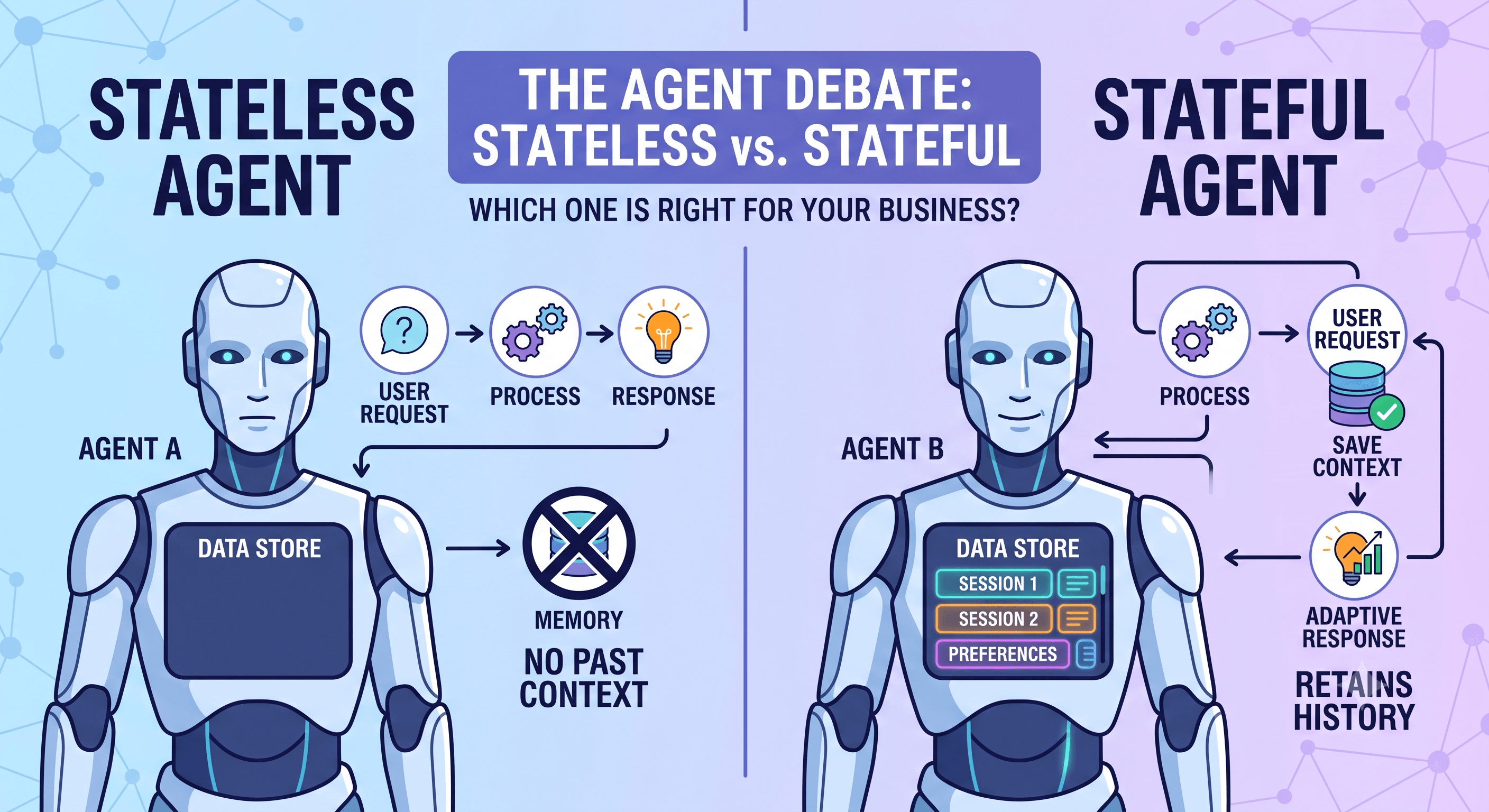
If you have started evaluating AI agents for your business, you have probably run into the words "stateless" and "stateful" without anyone explaining what they mean. The terms get used interchangeably in vendor demos, and the distinction sounds like an engineering detail. It is not. Whether an agent remembers what happened five minutes ago changes what it can do, what it costs, and where it can go wrong. This article explains both terms in plain language and shows where each one fits.
What "state" means for an AI agent
State is simply information an agent keeps between one interaction and the next. It is memory, in the everyday sense of the word.
When you talk to a colleague who remembers yesterday's meeting, you do not have to re-explain the project every morning. When you talk to someone who has never met you, you start from zero each time. That difference — carrying context forward versus starting fresh — is the difference between a stateful and a stateless agent.
The important thing to understand up front: the underlying AI model is the same in both cases. "Stateless" and "stateful" describe the system built around the model, not the model's intelligence. A stateful agent is not smarter; it just has access to a record of what came before.
What is a stateless AI agent?
A stateless AI agent treats every request as if it were the first one it has ever seen. It takes an input, produces an output, and keeps nothing afterward.
Each interaction is self-contained. Once the agent answers, it forgets the exchange entirely. The next request arrives with no knowledge that the previous one happened.
Concrete examples of stateless agents include:
- A translation function that converts a block of text from English to German.
- A document classifier that reads an invoice and tags it as "paid" or "unpaid."
- A support widget that answers a single, standalone question like "What are your business hours?"
- A summarizer that condenses an article you paste into it.
A simple way to think about it: a stateless agent is a vending machine. You put in a request, you get an output, and it does not remember you the next time you walk up.
What a stateless agent does not do is follow a conversation. Ask it a question, then ask "and what about the second option?" and it has no idea what "the second option" refers to, because it never retained the first answer. That is not a flaw — for many tasks, memory is unnecessary weight. But it is a hard boundary on what the agent can handle.
What is a stateful AI agent?
A stateful AI agent retains context across interactions. It remembers what was said, what was decided, and often what the user prefers, and it uses that history to inform later responses.
This memory can span a single conversation (short-term) or persist across days, weeks, and separate sessions (long-term). A stateful agent can pick up a thread you started last Tuesday, recall that you already provided your account number, or adjust its behavior based on choices you made earlier.
Concrete examples of stateful agents include:
- A customer-service agent that handles a multi-step return: confirming the order, checking the reason, and arranging a refund without asking you to repeat details.
- A coding assistant that remembers the structure of your project across a work session.
- An onboarding assistant that walks a new employee through a sequence of tasks over several days, tracking what is done and what remains.
- A research agent that gathers information across multiple steps, building on what it found earlier before producing a final answer.
A simple way to think about it: a stateful agent is a good assistant who keeps notes. Each time you talk, they already know where you left off.
What a stateful agent adds is continuity — and with it, complexity. Memory has to be stored somewhere, kept accurate, secured, and eventually cleared. A stateful agent that remembers the wrong thing, or holds onto sensitive data longer than it should, creates problems a stateless agent never could. Memory is a capability and a responsibility at the same time.
Stateless vs stateful: a side-by-side comparison
Concept | Plain explanation | Main purpose |
|---|---|---|
Stateless agent | Handles each request in isolation, remembers nothing afterward | Fast, simple, repeatable single-step tasks |
Stateful agent | Carries context forward across steps and sessions | Multi-step workflows and ongoing relationships |
State | The information an agent keeps between interactions | Lets the agent build on what came before |
Short-term memory | Context held within one conversation | Coherent back-and-forth in a single session |
Long-term memory | Context that persists across separate sessions | Personalization and continuity over time |
A realistic scenario using both
Imagine a customer contacts an online electronics retailer. Here is how the two agent types divide the work:
- 1.The customer types "Is the X200 laptop in stock?" A stateless agent handles this well: it takes the product name, checks inventory, and returns an answer. No memory required.
- 2.The customer replies, "Great — I want to return the one I bought last month and put the refund toward it." Now the request depends on history. A stateful agent takes over, pulling up the past order, confirming the customer's identity from earlier in the chat, and tracking the return through several steps.
- 3.Two days later, the customer returns and asks, "Where is my refund?" Because the stateful agent retained the case, it answers without making the customer re-explain anything.
Most real products use both kinds of behavior. The skill is knowing which parts of a workflow need memory and which do not, rather than making everything stateful by default.
Use cases: when to choose which
Choose a stateless agent when the task is a clean input-to-output transformation that does not depend on anything before it. Good fits include content classification, translation, data extraction, single-shot question answering, and high-volume automated tasks where each item is independent. Stateless agents are cheaper to run, easier to scale across many parallel requests, and simpler to test, because the same input reliably produces the same output.
Choose a stateful agent when the value comes from continuity. Good fits include multi-turn customer support, personal assistants, guided onboarding, long-running research or planning tasks, and any workflow where the agent must remember decisions made earlier to act correctly. Stateful agents enable experiences that feel coherent and personal, but they cost more to build and operate and require deliberate handling of stored data.
In practice, the choice is rarely all-or-nothing. A well-designed system often uses stateless components for the simple, repeatable parts and reserves statefulness for the moments that genuinely need it. Adding memory where it is not needed increases cost and risk without a matching benefit.
Why this matters for businesses
If you are deciding where to apply an AI agent, the stateless-versus-stateful question is really a question about the problem you are solving, not the technology you are buying.
Ask what the task actually requires. If each request stands on its own — sorting tickets, tagging documents, answering one-off questions — a stateless approach is faster, cheaper, and less risky, and paying for memory you do not use is waste. If the value depends on the agent remembering the customer, the case, or the conversation, then statefulness is not optional, and a stateless tool will frustrate users by making them repeat themselves.
The trade-off to watch is this: memory is where most of the cost, complexity, and data-protection risk lives. A stateful agent has to store information, which raises real questions about where that data sits, who can see it, how long it is kept, and how it is deleted — questions that matter more when the data is personal or regulated, as it often is under European data-protection rules. A vendor who cannot explain how their agent handles memory is a vendor to slow down with.
What "good" looks like is a system matched to the job: stateless where the work is simple and independent, stateful where continuity earns its keep, and a clear, documented answer to how any retained data is stored and protected. The goal is not the most advanced agent; it is the right amount of memory for the outcome you need.
Quick reference
- Stateless agent — handles each request in isolation and remembers nothing afterward.
- Stateful agent — carries context across steps and sessions to maintain continuity.
- State — the information an agent keeps between interactions.
- Short-term memory — context held within a single conversation.
- Long-term memory — context that persists across separate sessions, enabling personalization.
- Rule of thumb — use stateless for simple, independent tasks; use stateful when the agent must remember to be useful.
Conclusion
The difference between stateless and stateful AI agents comes down to one thing: whether the agent carries context forward. That single choice shapes what an agent can do, what it costs to run, and how carefully you have to handle the data it holds. Most effective systems combine both, applying memory only where it earns its place.
Getting that balance right is a design decision, and it is one ITGRATE helps clients make when we build products for them. As a software development agency with teams in Munich and Ho Chi Minh City, we work with European businesses to design and build AI-enabled products — from a first working version through a dedicated product team that scales it — with the architecture and data handling thought through from the start. The teams that get the most from AI agents are not the ones that add the most memory; they are the ones that add it where it counts and leave it out where it does not.