

Discover why AI is shifting software development from specialized roles toward product builders who combine engineering, product thinking, and AI orchestration to deliver business impact.
Artificial Intelligence is changing software development faster than any technology shift in recent decades. Most discussions still focus on whether AI will replace software developers. While understandable, this is arguably the wrong question.
The more important question is:
What kind of software professional will create the most value in an AI-first world?
Increasingly, the answer is the Product Builder. Not simply a software engineer. Not just a Product Owner. Not merely someone who writes better prompts.
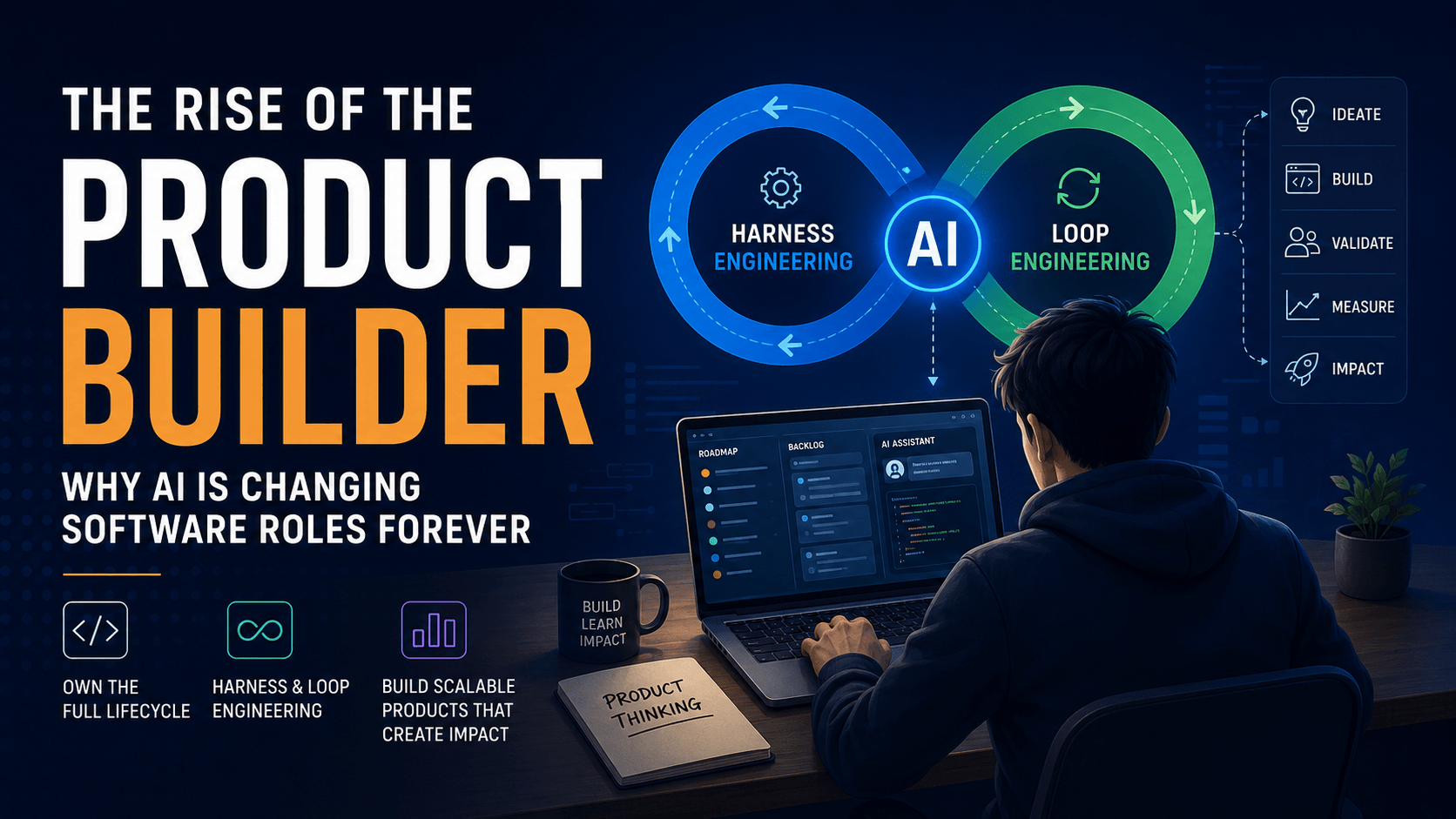
A Product Builder combines engineering expertise, product ownership, systems thinking, and AI-native workflows to build products that create measurable business impact.
Software Development Is Moving Beyond Specialization
Over the past two decades, software organizations became increasingly specialized.
A typical delivery team consists of:
- Product Manager
- Product Owner
- UX/UI Designer
- Backend Engineers
- Frontend Engineers
- Mobile Engineers
- QA Engineers
- DevOps Engineers
- Scrum Master
This specialization improved quality and enabled larger, more complex software projects.
However, it also introduced new challenges:
- More handovers
- Longer feedback cycles
- Communication overhead
- Context loss between teams
- Slower decision-making
Every additional role creates another transition where information can be misunderstood or delayed. AI is beginning to remove much of this execution friction.
AI Doesn't Replace Engineering—It Changes Where Value Is Created
Modern AI can already:
- Generate production-ready code
- Write automated tests
- Produce technical documentation
- Explain legacy systems
- Review pull requests
- Generate API clients
- Suggest architecture improvements
- Assist with debugging
The bottleneck is no longer writing code. The real bottlenecks are now:
- Understanding customer problems
- Making the right product decisions
- Designing scalable systems
- Managing complexity
- Creating sustainable architectures
- Validating assumptions
- Coordinating AI effectively
As AI becomes increasingly capable, technical execution becomes cheaper. Product thinking becomes more valuable.
Enter the Product Builder
A Product Builder owns the complete lifecycle of a product. Unlike traditional roles that optimize individual phases of delivery, the Product Builder continuously optimizes the entire system.
They usually come from a strong engineering background while also developing the mindset of an experienced Product Owner.
Instead of asking:
"How do we implement this feature?"
they ask:
"Should we build this at all, and if yes, what is the fastest, safest and most scalable way to create business value?"
Their success is measured by outcomes rather than output.
What Does a Product Builder Actually Do?
A Product Builder continuously moves between multiple perspectives.
They:
- Discover customer problems
- Validate ideas quickly
- Design scalable architectures
- Build AI-assisted development workflows
- Prioritize business value
- Measure customer outcomes
- Improve products through continuous feedback
Rather than owning a backlog, they own the product.
AI-Native Product Development
One of the biggest differences is how Product Builders use AI. They don't simply ask ChatGPT to write code. They build systems around AI.
Two concepts become increasingly important:
- Harness Engineering
- Loop Engineering
Harness Engineering: Giving AI the Right Context
Large Language Models are only as effective as the environment they operate within. Harness Engineering focuses on creating this environment.
Instead of isolated prompts, AI receives structured context such as:
- Coding standards
- Architecture documentation
- Design systems
- Business rules
- Existing codebases
- API specifications
- Security requirements
- Testing frameworks
- Project conventions
This dramatically improves consistency and reliability. Instead of repeatedly explaining the project, the Product Builder designs a reusable system where AI always has the information it needs.
Loop Engineering: Designing Continuous Improvement
Software is never finished. Neither should AI be. Loop Engineering creates structured feedback loops that continuously improve both the product and the AI-assisted development process. Every iteration makes the system better. Rather than treating AI as a coding assistant, Product Builders treat AI as part of a continuous product delivery engine.
Engineering Still Matters
The rise of AI has led some people to believe that technical expertise is becoming less important. In reality, the opposite is happening. AI makes building prototypes remarkably easy. But prototypes are not products.
Real products require:
- Architecture
- Security
- Scalability
- Performance
- Monitoring
- Maintainability
- Compliance
- Reliability
- Operational excellence
Without engineering fundamentals, organizations risk confusing a functional prototype with production-ready software. This may become one of the largest risks of AI adoption.
Product Ownership Is Becoming More Technical
Traditional Product Owners focused primarily on:
- Writing user stories
- Prioritizing backlogs
- Managing stakeholders
- Sprint planning
While these responsibilities remain important, AI changes expectations. Future Product Owners increasingly need to understand:
- APIs
- Software architecture
- AI capabilities
- Automation
- Data structures
- Technical constraints
Not necessarily to write production code, but to make technically informed product decisions. The line between engineering and product management is becoming increasingly blurred.
From Feature Delivery to System Design
Traditional software teams often optimize feature delivery. Product Builders optimize systems.
Instead of asking:
"When will Feature X be finished?"
they ask:
- Will this scale?
- Is this maintainable?
- Can AI automate parts of this?
- Are we solving the right problem?
- How do we shorten future delivery cycles?
Their thinking extends far beyond the next sprint.
The Skills of a Product Builder
Competency | Why It Matters |
|---|---|
Software Engineering | Build scalable, reliable systems |
Product Ownership | Prioritize business value |
Systems Thinking | Understand the entire lifecycle |
AI Orchestration | Effectively use Harness & Loop Engineering |
Customer Empathy | Solve meaningful problems |
Business Understanding | Align technology with commercial goals |
Data-Driven Decision Making | Measure outcomes instead of activity |
Communication | Connect business and engineering |
The Product Builder is not simply a hybrid role.
It represents a fundamentally different mindset.
Why This Matters for Organizations
Organizations adopting AI successfully are unlikely to succeed merely because they purchased better AI tools. Their competitive advantage comes from redesigning how products are built.
That means empowering people who can:
- Think strategically
- Understand engineering
- Use AI responsibly
- Make fast product decisions
- Continuously improve delivery systems
These individuals multiply the effectiveness of entire teams.
Final Thoughts
AI is not reducing the importance of engineering. It is increasing the importance of engineering combined with product thinking. The highest-value professionals of the coming decade will not be those who can write the most code.
They will be those who can combine:
- Engineering depth
- Product ownership
- Systems thinking
- AI orchestration
- Business understanding
into one continuous product-building capability. The future belongs to professionals who own outcomes—not just tasks.
The future belongs to Product Builders.
Soft CTA
Artificial Intelligence is transforming how software is built, but lasting success comes from combining the right engineering practices with strong product thinking. At ITGRATE, we help organizations build AI-native software delivery capabilities by integrating modern engineering, Product Ownership, Harness Engineering, and Loop Engineering into scalable development processes that create measurable business impact.