

AI-assisted software development is more than generating code with prompts. This article compares vibe coding, prompt engineering, harness engineering, and loop engineering, explaining how each approach fits into a professional software development process and where structured engineering practices remain essential.
AI-assisted software development has moved quickly from experimentation into real project environments. Teams are no longer only asking whether AI can write code. The more relevant question is how AI can be integrated into a reliable software development process.
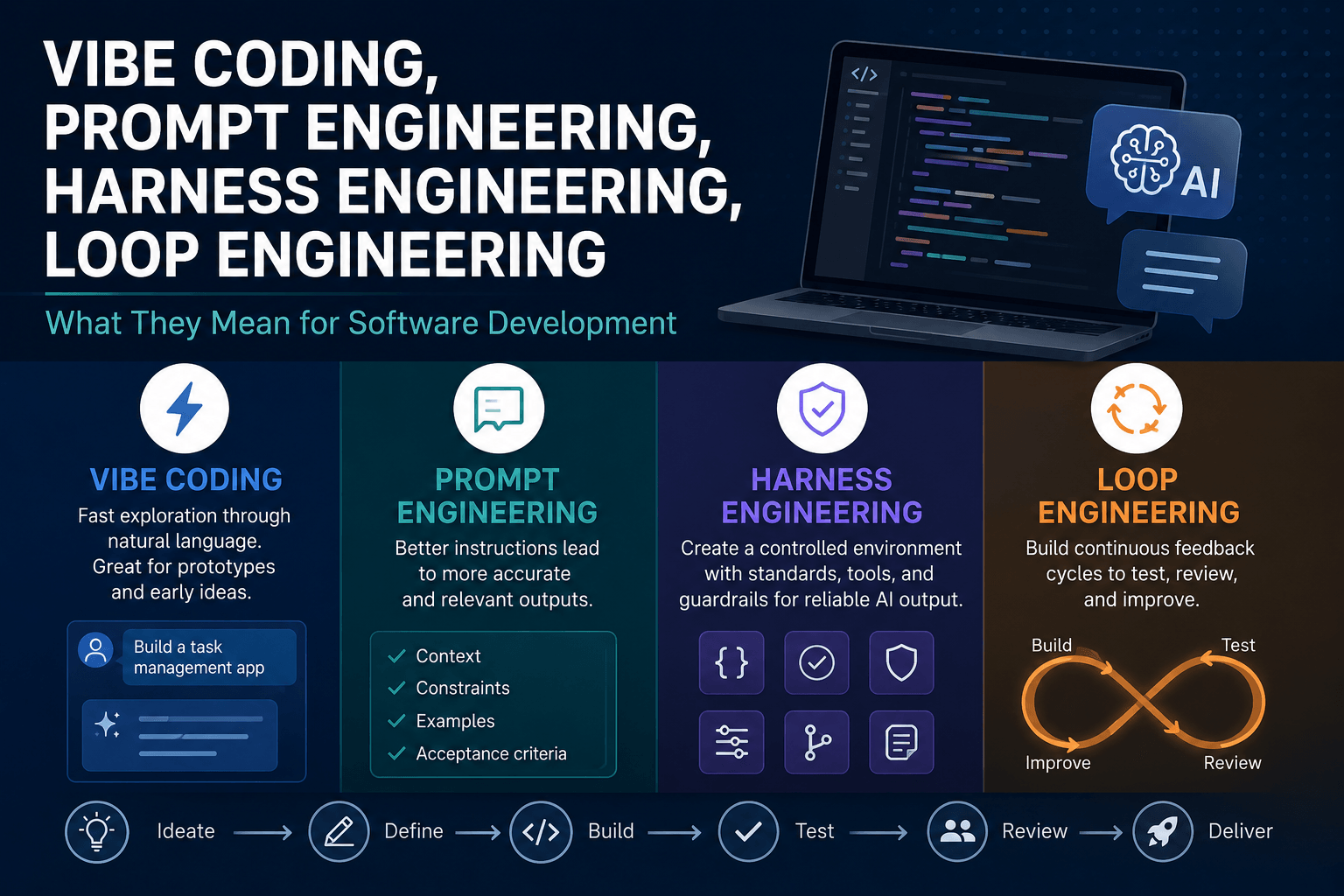
Several terms are now used to describe different ways of working with AI: vibe coding, prompt engineering, harness engineering, and loop engineering. While they are sometimes discussed as trends, they represent different levels of maturity in how development teams use AI.
For companies building production software, the distinction matters. The goal is not to generate more code faster at any cost. The goal is to improve delivery speed while maintaining quality, security, maintainability, and business alignment.
1. Vibe Coding: Fast Exploration, Limited Control
Vibe coding describes a highly intuitive way of using AI to build software. A developer or product person describes what they want in natural language, lets the AI generate code, tests the result, and continues adjusting through conversation.
This approach can be useful in early-stage exploration. It allows teams to quickly create prototypes, validate ideas, and test user flows without investing heavily in architecture or detailed specifications upfront.
In a software development process, vibe coding is most useful for:
- Rapid prototyping
- Internal demos
- Early UI experiments
- Exploring technical possibilities
- Building throwaway proof-of-concepts
The limitation is that vibe coding often lacks structure. Requirements may be unclear. Architectural decisions may be inconsistent. Testing may be incomplete. Security and scalability are often not considered deeply enough.
For production software, vibe coding alone is usually not sufficient. It can accelerate the first draft, but it should not replace engineering discipline.
2. Prompt Engineering: Better Instructions, Better Outputs
Prompt engineering focuses on giving AI better instructions. Instead of asking broadly for “an app” or “a feature,” the user provides context, constraints, examples, acceptance criteria, and expected output formats.
In software development, prompt engineering improves the quality of AI-generated work by making requirements more precise. A good prompt can guide the AI to follow a specific framework, coding style, database structure, API convention, or testing approach.
For example, instead of asking:
“Build a login page.”
A more useful prompt would define:
- The frontend framework
- Authentication flow
- Validation rules
- Error states
- Design system constraints
- Security expectations
- Test cases
- API contract
Prompt engineering is valuable because it improves communication between humans and AI. However, it still depends heavily on the skill of the person writing the prompt. If the context is incomplete, the output may still be wrong, inconsistent, or difficult to maintain.
In a professional development process, prompt engineering is a useful skill, but it should be supported by standards, documentation, review, and testing.
3. Harness Engineering: Creating a Controlled Environment for AI
Harness engineering goes one step further. Instead of relying only on individual prompts, it creates a structured environment around the AI.
A harness can include templates, coding standards, test suites, linters, CI/CD pipelines, documentation, evaluation scripts, and predefined workflows. The purpose is to make AI output more reliable and easier to verify.
In practical terms, harness engineering asks:
“How do we create a system where AI can contribute safely and consistently?”
For software teams, this can mean:
- Using predefined task templates
- Connecting AI to project documentation
- Enforcing coding standards automatically
- Running tests after code generation
- Checking security rules
- Validating API compatibility
- Reviewing generated changes before merge
- Measuring output quality
Harness engineering is especially important when AI is used in real development workflows. It helps reduce randomness and creates guardrails around the AI’s contribution.
This is where AI-assisted development becomes less about isolated prompting and more about engineering process design.
4. Loop Engineering: Building Continuous Feedback Cycles
Loop engineering focuses on feedback cycles. AI generates an output, the system tests or evaluates it, feedback is provided, and the AI or developer improves the result.
In software development, this mirrors how good teams already work: build, test, review, improve, and repeat. The difference is that AI can now participate in parts of the loop.
A development loop may include:
- Requirement clarification
- Code generation
- Automated testing
- Static analysis
- Security checks
- Human code review
- Bug fixing
- Documentation updates
- Deployment validation
- User feedback
Loop engineering is not only about making AI write better code. It is about designing a repeatable process where AI-supported work can be checked, corrected, and improved continuously.
This is important because AI can be productive, but it is not inherently reliable. A good loop catches mistakes early. It reduces the risk of shipping broken, insecure, or misaligned software.
Comparing the Four Approaches
Approach | Main Focus | Best Use Case | Main Risk |
|---|---|---|---|
Vibe coding | Fast creation through natural language | Prototypes and experiments | Low control and inconsistent quality |
Prompt engineering | Better instructions to AI | More accurate AI outputs | Depends on prompt quality |
Harness engineering | Controlled AI development environment | Production-oriented workflows | Requires setup and process discipline |
Loop engineering | Feedback and improvement cycles | Reliable delivery and continuous quality | Needs strong testing and review culture |
These approaches are not mutually exclusive. A mature software team may use all of them at different stages.
Vibe coding can help explore an idea. Prompt engineering can make the request clearer. Harness engineering can ensure the output follows project standards. Loop engineering can continuously test, review, and improve the result.
The key is knowing when each approach is appropriate.
What This Means for Software Development Teams
AI does not remove the need for software engineering. It changes where engineering effort is applied.
In traditional development, much effort goes into manually writing implementation details. With AI, some of that effort moves toward defining requirements, designing workflows, setting up validation systems, and reviewing generated outputs.
This means development teams need to strengthen several capabilities:
- Clear requirement writing
- Strong technical architecture
- Automated testing
- Code review discipline
- Security awareness
- Documentation quality
- Continuous delivery processes
AI can increase speed, but only when the surrounding process is strong enough to absorb that speed safely.
Without structure, AI can create technical debt faster than a human team can manage it. With the right process, AI can become a useful accelerator for delivery.
From AI Experimentation to Reliable Delivery
For business leaders, the practical question is not whether developers are using AI. Many already are. The more important question is whether AI is being used in a controlled and professional way.
A prototype generated through vibe coding may be enough to test an idea. But a production system needs more:
- Clear scope
- Stable architecture
- Secure implementation
- Maintainable code
- Automated testing
- Deployment control
- Long-term support
This is where experienced software teams add value. The benefit of AI is not just faster code generation. The real value comes from combining AI capabilities with professional engineering practices.
Conclusion
Vibe coding, prompt engineering, harness engineering, and loop engineering represent different stages of AI maturity in software development.
Vibe coding helps teams move quickly. Prompt engineering improves communication with AI. Harness engineering creates control. Loop engineering builds reliability through feedback.
For professional software development, the future is not about replacing engineering with prompting. It is about integrating AI into a disciplined process that produces software that can be tested, maintained, secured, and scaled.
At ITGRATE, we help companies turn software ideas into reliable digital products by combining modern development practices with practical delivery experience. If your team is exploring how AI-assisted development can support your next product or internal platform, we can help you assess the right approach and build a process that fits your business goals.