

Cross-platform vs Native - in the age of AI
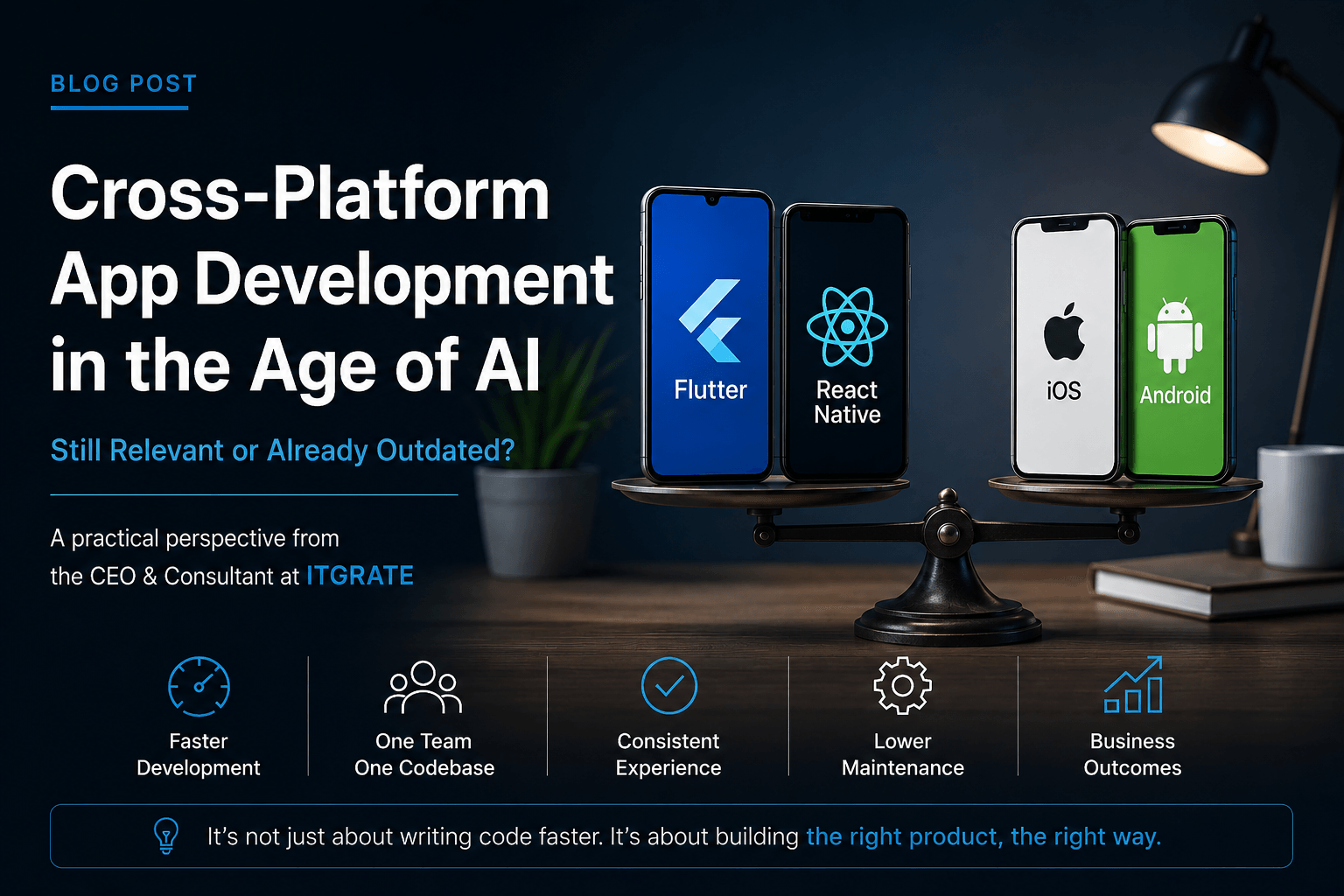
As CEO and Consultant at ITGRATE, I spend a lot of time thinking about technology decisions not from a purely technical perspective, but from a business and delivery perspective.
One question that comes up more often now is whether cross-platform frameworks like Flutter or React Native still make sense. With AI-assisted development tools, agentic coding workflows, and increasingly powerful CLI-based development environments, native iOS and Android development has become much faster than it used to be.
So the question is fair: If AI can help us build native apps faster, why should we still use Flutter or React Native?
My answer is: yes, cross-platform development is still relevant — but the reason for using it has changed.
AI Reduces Coding Effort, But Not Product Ownership
AI tools are already useful in native app development. They can help generate SwiftUI or Jetpack Compose screens, write boilerplate, explain build errors, draft tests, and translate implementation patterns between iOS and Android.
This makes native development more attractive than it was a few years ago.
However, there is a difference between writing code and owning a product.
Even if AI helps you generate native code faster, you still need to maintain two separate applications. You still need to think about two architectures, two QA processes, two release pipelines, two platform-specific bug surfaces, and two sets of long-term technical decisions.
That is the part many people underestimate.
AI can reduce the cost of producing code. It does not remove the cost of maintaining two products.
The Old Argument for Cross-Platform Is Weaker
In the past, one of the strongest arguments for Flutter or React Native was simple: native development was expensive because you had to build everything twice.
That argument is weaker now.
With better tooling, modern native UI frameworks, and AI-assisted development, building native apps is no longer as slow as it used to be. For teams with strong iOS and Android expertise, native development can be very efficient.
This means cross-platform frameworks should no longer be chosen automatically just because “native is too expensive.”
That is not a strong enough argument anymore.
The Stronger Argument: Organizational Simplicity
For me, the stronger argument for Flutter or React Native is not only technical. It is organizational.
Cross-platform frameworks can give you:
- one product implementation
- one shared team
- one design system
- one testing strategy
- one release rhythm
- one shared understanding of product behavior
That matters a lot in real client projects.
At ITGRATE, we often work with SMEs, consulting firms, and product teams that care about speed, reliability, and business outcomes. Their first concern is usually not whether a button follows the exact native behavior of iOS or Android. Their first concern is whether the product solves the right problem, reaches users quickly, and can be maintained without unnecessary overhead.
For these cases, Flutter or React Native can still be the pragmatic choice.
When Cross-Platform Still Makes Sense
I would still seriously consider Flutter or React Native for many types of business applications.
For example:
- MVPs
- internal business apps
- customer portals
- booking systems
- marketplace apps
- content apps
- dashboard-heavy applications
- apps with many forms and workflows
- products where iOS and Android should behave almost identically
In these cases, the main business value does not come from deep platform-specific optimization. It comes from shipping the right product, validating the business case, and maintaining a consistent experience across platforms.
A shared codebase can reduce friction. It can make the team faster. It can make planning easier. It can also reduce the risk that iOS and Android slowly drift apart over time.
That drift is a real problem. It happens quietly. One platform gets a small feature earlier. Another handles an edge case differently. A bug is fixed on Android but not on iOS. Over time, the product becomes harder to manage.
Cross-platform development can help prevent that.
When Native Is the Better Choice
There are also clear cases where I would prefer native development.
For example:
- apps with deep iOS or Android integrations
- Bluetooth-heavy or hardware-heavy apps
- camera, audio, or video-intensive apps
- apps requiring complex background behavior
- Apple ecosystem-heavy products
- apps where platform-native UX is a core competitive advantage
- products with large enough budgets to sustain separate native teams
In these situations, native development is often the better long-term choice.
This is especially true when the app depends heavily on platform capabilities. If the product needs to use the operating system in advanced ways, a cross-platform abstraction can become a limitation instead of an advantage.
AI makes native development more accessible, so I would now recommend native more often than I did in the past for these cases.
Flutter vs React Native: A Practical View
I do not see Flutter and React Native as interchangeable in every situation.
Flutter is strong when you want a highly controlled, consistent UI across platforms. It is also a good fit when the mobile app is the center of the product and the team is comfortable working within the Flutter ecosystem.
React Native is strong when the company already has a React or TypeScript team. In that case, React Native can fit naturally into the existing engineering culture. It can also make sense when there is a web product and the company wants to reuse knowledge, patterns, and sometimes parts of the frontend architecture.
The decision should not be based on trends. It should be based on team structure, product requirements, expected maintenance, and business goals.
What AI Actually Changes
AI changes the calculation, but not the fundamentals.
It makes native development faster. It makes refactoring easier. It helps teams understand unfamiliar platform APIs. It can support testing, documentation, and debugging.
But it does not remove the need for architectural ownership.
It does not decide which platform behavior is correct.
It does not take responsibility for quality.
It does not replace a team’s understanding of the product.
And it does not remove the cost of maintaining two separate systems over several years.
That is why I would be careful with the claim that AI makes cross-platform frameworks obsolete. That sounds attractive, but it ignores the operational side of software development.
My Current Rule of Thumb
My current view is simple:
Use cross-platform when you want one product, one team, and one shared delivery process. Use native when platform-specific quality, performance, or OS integration is central to the product.
For many client projects, especially in the SME and startup environment, cross-platform is still a very reasonable default.
For complex consumer products, hardware-related applications, or apps with strong platform-specific requirements, native becomes more attractive — especially now that AI can reduce some of the development overhead.
Conclusion
Cross-platform app development is not dead. But the reason for using it has matured.
It should no longer be sold only as a way to “save development costs.” That is too simplistic.
The better argument is this:
Cross-platform frameworks reduce coordination cost, maintenance complexity, and product inconsistency.
AI will continue to improve native development. That is a good thing. But software projects do not fail only because code is slow to write. They fail because teams lose clarity, products become inconsistent, maintenance becomes expensive, and technical decisions are made without enough business context.
From that perspective, Flutter and React Native still have a clear place.
But when the business needs one consistent product across platforms, delivered by a focused team with a clear process, cross-platform development still makes a lot of sense.